The essential takeaway: a desert dinner serves as an immersive theatrical event where the setting outweighs the menu. Prioritizing conservation reserves or private camps ensures a genuine escape rather than a crowded tourist trap. While budget options start around $40, the true value lies in the mid-range semi-private tier for an authentic, unforgettable night under the stars.
Are you terrified that your dream evening might turn into an overpriced tourist trap with mediocre food and hundreds of loud strangers? This expert guide dissects the actual reality of a dinner in the desert, ruthlessly filtering the genuine, high-value experiences from the dusty, crowded scams that plague the market. From decoding the hidden costs in every package to choosing the perfect outfit for the sharp temperature drop, here is the strategic roadmap to guarantee a flawless night under the stars without wasting your time or money.
What Exactly Is a Desert Dinner? Forget the Clichés
It’s Not Just a Meal, It’s a Staged Event
A dinner in the desert is less about the food and more about a calculated immersive experience. Think of it as open-air theater where the Agafay landscape itself acts as the main character.
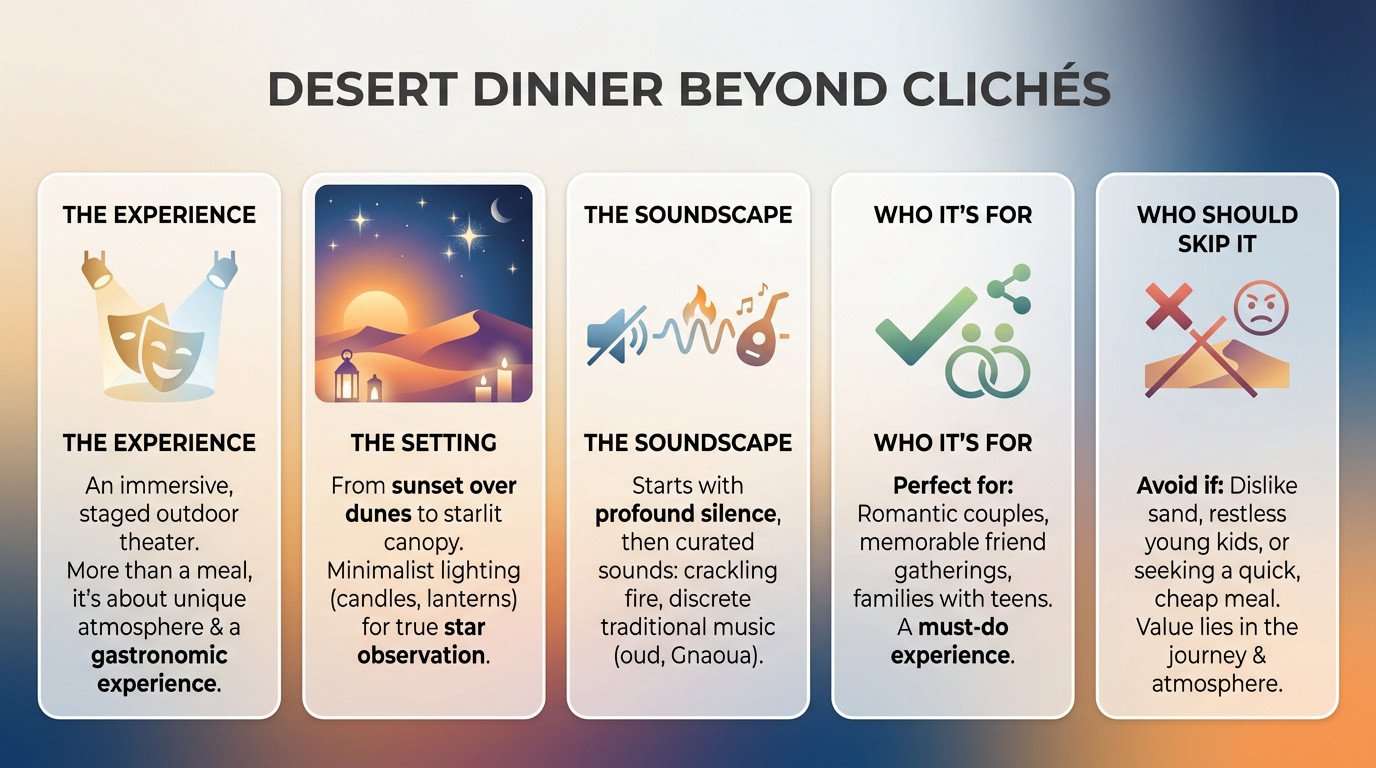
Every detail is staged for impact, from the intricate Persian carpets underfoot to the precise geometric arrangement of lanterns.
You are paying to enter a bubble outside of time, completely isolated from the city’s noise. It is the unique atmosphere and seclusion you buy, not just a meal, creating a truly distinct gastronomic experience.
The Setting: From Sunset Glow to Starlit Canopy
The show actually begins before the food arrives, timed perfectly to catch the sunset over the dunes. In the rocky Agafay desert, this shift in light is the critical opening act.
Once night officially falls, the vibe shifts instantly. The lighting becomes intentionally minimalist, relying on flickering candles, lanterns, and campfires to maintain the mood.
Without the city’s light pollution, the darkness is absolute. This is one of the rare chances to witness a true sky, making professional stargazing a frequent and spectacular bonus included in the package.
The Soundscape: Silence, Traditional Music, and Crackling Fire
The first thing that hits you is the profound silence. It is heavy, total, and unlike anything you hear in the city, making this absolute quietude a rare luxury item. You forget how loud the world is until it stops.
This void is carefully filled with curated sounds like the snap of a fire or discrete live Gnaoua music. It never overpowers the conversation; it acts as a subtle background soundtrack rather than a loud concert, keeping the vibe intimate.
Who Is This For (And Who Should Skip It)
Here is my verdict: this is ideal for couples needing romance, friends wanting a memory, or families with teens. It is an experience to do at least once if you value atmosphere over price.
However, you should skip this if you hate sand, have restless toddlers, or are just looking for a quick, cheap meal. The transfer time and the time spent on-site are part of the cost, so patience is required to enjoy it. Don’t force it if you prefer efficiency.
The Different Flavors of Desert Dining: From Rugged to Ritzy
If you want the « Instagram shot » without the grit, this is it. We are talking about five-star service transposed directly into the dunes. You get crisp white linens, heavy silverware, and waiters who watch your glass like hawks. It feels surreal.
Forget the dry buffet lines you see elsewhere. Here, a dedicated chef prepares a multi-course menu, often plating dishes like art. It is basically fine dining with a million-dollar view.
This is strictly for anniversaries or proposals. You pay a premium—often starting around 1000 MAD per person at places like Inara—but the silence is absolute.
The Traditional Bedouin-style Camp: Authenticity First
This is the raw, honest version I actually prefer for groups. The setup is simple: colorful Berber rugs on the sand, low tables, and plenty of cushions. It feels grounded.
Here, the focus shifts to local culture rather than fancy plating. You usually dig into a generous buffet of tagines and grilled meats while sitting shoulder-to-shoulder with others. The vibe is loud, shared, and genuinely fun.
For a first trip, this offers the best value. You get the flavor without burning your wallet.
The Adventure Pop-up: For the Explorers
These are not permanent tourist traps. Companies like Cloth & Flame in the US build temporary, stunning events in places like the Superstition Mountains. You buy a ticket, show up, and the whole thing vanishes the next day.
Often, they keep the exact coordinates secret until 24 hours before. You end up dining in a wild and preserved site, completely isolated from the usual 4×4 circuits.
It combines serious gastronomy with raw exploration. Plus, a chunk of your ticket often supports land conservation, so it feels good.
Private Bubble vs. Shared Camp: What’s the Real Difference?
You have to decide if you want to see other humans or not. A private tent—like the « Prestige » options in Agafay—gives you total isolation, perfect for couples who want to talk. The service comes to you, so you never lift a finger.
On the flip side, a shared camp is where the energy happens. You meet other travelers, swap stories, and get front-row seats to the Gnawa musicians or fire eaters. It depends entirely on your mood that night.
The Culinary Side: What Are You Actually Eating?
The atmosphere is undeniable, but let’s be real: you are also here to eat. So, beyond the sand and the sunset, what exactly lands on your plate during a dinner in the desert? Here is the breakdown of the menu.
The Traditional Feast: A Spread of Local Flavors
Standard camps usually kick off the meal with a generous assortment of Arab mezze. You are looking at reliable classics like creamy hummus, smoky moutabal, fresh tabouleh, and bread baked right on site. It is simple, effective, and honestly, often the best part of the entire meal.
For the main event, the kitchen almost always rolls out a mixed grill barbecue featuring chicken skewers, lamb chops, and seasoned kofta. Sometimes, they swap the grill for a slow-cooked dish like a rich tagine or an ouzi, where the lamb is roasted until it falls off the bone.
Gourmet Dining Under the Stars: The Chef’s Touch
If you upgrade to the luxury options—like the « Prestige » tent at Inara Camp—forget the buffet line. You get a multi-course tasting menu plated with the precision of a top-tier city restaurant. It is not just food; it is a designed experience meant to justify the premium cost.
We are talking about ingredients like scallop carpaccio with truffles or beef fillet with Roquefort sauce. The chefs use modern techniques here, ensuring the quality matches the steep price tag you paid.
Hauling fresh scallops into the middle of the dunes is a logistical nightmare. That effort is exactly what you are paying for when the bill hits 1000 MAD per person.
Cooking Methods: From Earth Ovens to Live Grilling Stations
The preparation is half the show at these events. Many venues set up live cooking stations where you watch the chefs work directly over open flames. Charcoal grilling is the standard, adding that necessary smoky flavor to the meats before they hit your table.
You might also see traditional methods like the « zarb, » where meat is slow-cooked in an oven dug into the sand. It serves a dual purpose: it is an ancient cooking technique and a fantastic piece of visual entertainment for the guests.
What About Drinks? From Mint Tea to Craft Cocktails
Let’s talk hydration. Sweet mint tea is the non-negotiable welcome drink, and water is standard. It is the absolute foundation of desert hospitality, so do not expect to pay extra for these basics.
Alcohol is where it gets tricky. In places like Agafay, tourist camps often have licenses, but standard €50 packages rarely include booze. Luxury spots offer signature cocktails and wine lists, but you must check the fine print. That bottle of wine can easily double your final tab if you aren’t paying attention.
Beyond the Plate: The Full Desert Experience
You might think you are just booking a meal, but a dinner in the desert is actually a carefully orchestrated production. It is a package deal designed to keep you entertained from the moment the 4×4 hits the dunes until you are dropped back at your Riad. Here is the breakdown of what you are actually paying for.
The Classic Activities: Camels, Quads, and Sandboarding
Let’s be honest, the sunset camel ride is the ultimate tourist cliché, but you absolutely need that photo. It usually lasts about 15 to 20 minutes, just enough time to feel the rhythm of the dunes without getting sore. It is the standard opener for nearly every Agafay package.
If you prefer adrenaline over a slow wobble, many operators offer quads or buggies to tear up the terrain before eating. Sandboarding is often available too—it is surprisingly fun and requires zero skill to slide down a dune. Just double-check your booking; these mechanical toys often cost extra, unlike the boards.
The Evening Entertainment: Fire Shows and Local Artistry
Once the sun dips below the horizon, the real show kicks off. The fire eater performance is a staple, and I have to admit, seeing those flames cut through the pitch-black desert night is genuinely impressive.
Music anchors the whole vibe. You will hear the rhythmic clatter of qraqeb castanets from Gnaoua musicians or watch Tanoura dancers spin endlessly in their illuminated skirts. It is loud, colorful, and keeps the energy high while you finish your tagine.
Don’t expect a quiet candlelight dinner; this is a full-blown production. Most camps follow a specific entertainment roster to keep you engaged between courses:
- Typical evening shows: Fire dancing and breathing
- Traditional music performances (Oud, Gnaoua)
- Tanoura and belly dancing shows
Cultural Touches: Henna, Falcons, and Shisha
Between acts, smaller cultural experiences fill the gaps in the schedule. Henna tattooing is almost always on the menu, especially for the ladies. It is a temporary, intricate design applied to the hand—a nice, authentic souvenir that fades after a week.
You might also spot a falconer showing off his bird, a nod to ancestral hunting traditions in the region. Afterward, there is usually a dedicated corner to relax and smoke shisha. It is the perfect way to digest the heavy meal before the drive back.
Stargazing: A Guided Tour of the Cosmos
Now, this is where the premium packages really shine. Some operators, like Inara Camp, offer a dedicated stargazing session. An astronomer sets up a professional telescope to guide you through the constellations, far from the city’s light pollution.
This is a game-changer. Seeing the Milky Way with the naked eye is rare these days. If your budget allows for this add-on, foncez. It transforms a loud dinner party into a moment of absolute silence and awe.
The Dubai Deep-Dive: My Picks and What to Avoid
You think you know what a dinner in the desert entails? Think again. It is not just eating outside; it is a calculated collision of high-end gastronomy and raw nature. We are talking about immersive staging where the lighting comes from crackling fire pits and the Milky Way, not cheap LEDs. The food isn’t just sustenance; it is often a fusion of Middle Eastern heritage and modern culinary techniques, cooked right before your eyes in the sand.
But here is the brutal truth: most travelers get this wrong. They book the first cheap ad they see, expecting magic, and end up in a neon-lit parking lot with cold hummus. I’ve tested them all—from the ultra-luxe conservation spots to the gritty budget camps—so you don’t have to waste your evening. The desert is unforgiving if you choose poorly. You risk losing not just your money, but a night of your life you can’t get back. But get it right? It’s the best meal you’ll ever have. Let’s cut through the marketing noise.
The Real Deal: Dining in a Conservation Reserve
My number one rule: stick to operators working within the Dubai Desert Conservation Reserve (DDCR). This is the only way to guarantee quality and environmental respect. You aren’t just paying for food; you are paying for protected silence.
Top-tier operators like Sonara Camp or Platinum Heritage run the show here. Access is strictly regulated, meaning zero crowds. You get space to actually breathe and appreciate the setting.
Plus, your chances of spotting local wildlife, like gazelles or oryx, skyrocket. It is nature, not a theme park.
The Tourist Trap: The Overcrowded Shared Camps
Be very careful with those bargain-bin offers. They usually dump you into massive camps where hundreds of tourists get packed in tight. It feels less like an adventure and more like a chaotic cafeteria line.
The buffet often tastes like cardboard, activities are timed to the second, and the vibe is pure factory production. It kills the magic completely. Run away from promises that look too good to be true.
Marcs Verdict: Is It Better Than Other Dubai Dining Experiences?
A dinner in the desert is a standalone beast, focused entirely on nature and escape. You cannot compare it to a city restaurant, even one sitting at the top of the Burj Khalifa. The silence of the dunes creates an atmosphere you just can’t manufacture inside a glass tower.
But if you want another iconic vibe, don’t ignore the water. For a totally different city view, a dhow cruise dinner in the Marina offers a spectacular perspective from the canal, right amidst the illuminated skyscrapers. It is the perfect contrast to the sand.
Logistics Hack: Self-Drive vs. Included Transfer
Almost every legitimate tour includes a 4×4 transfer directly from your hotel. It is the simplest solution and I highly recommend it. The drive often includes a « dune bashing » session, which is half the fun anyway.
Some camps allow you to come with your own vehicle. It is an option if you have a 4×4 and know sand driving. Otherwise, forget it.
The Marrakech Magic: Agafay Desert Explained
Let’s change the scenery. Just outside Marrakech, a different kind of wilderness pulls in travelers: Agafay. But listen closely, because this isn’t what most brochures sell you. Here is the reality check regarding the difference between Agafay and the Sahara, and why it matters for your wallet and your schedule.
Agafay 101: It’s a Rock Desert, Not Sand
Here is the detail that 90% of tourists miss until they arrive. The Agafay desert is simply not the Sahara you see in movies. You will not find endless golden sand dunes here; instead, it is a moon-like landscape of arid rocks and stone hills. It is raw, rugged, and totally different from the postcards.
But here is why you should care about this spot. It sits less than an hour from Marrakech, making it the ultimate evening escape without the travel fatigue. The scenery, while rocky, remains absolutely spectacular and offers a silence you can’t find in the city.
The Agafay Experience: What to Expect
Think of it as the Dubai desert experience, but with a bit more soul. You get the full package: dinner under canvas, rhythmic Gnaoua music, fire-eaters, and the inevitable camel ride. The atmosphere leans heavily towards bohemian-chic rather than traditional rustic. It feels curated, yet undeniably immersive for a quick getaway.
Luxury operators have taken over this space, setting up stunning outposts like Inara Camp. They offer exclusive dining inside private tents or at central restaurants with panoramic views. It is designed for comfort, not survival, and the staging is impressive.
A Look at the Prices: From 550 to 1000 MAD
Let’s talk numbers, because that is where people get confused. At a benchmark spot like Inara Camp, a standard dinner in the desert at the central restaurant (La Rotonde) starts at 550 MAD per person. That is your baseline entry point for quality food and a safe environment.
If you want privacy, the price jumps to between 650 and 850 MAD for a private tent. The top-tier option, the Sultane tent with a killer view, hits 1000 MAD. You pay for the exclusivity, not just the tagine.
Maroc’s Verdict: Is Agafay Worth It?
Absolutely, especially if you value your time. If you lack the days (and budget) for a multi-day trek to the real Sahara, Agafay is a fantastic alternative. It delivers the visual drama without the exhaustion of a ten-hour drive.
You capture the core elements—the stunning sunset, the heavy silence, and dining under the stars—minus the logistical nightmare of a long haul. It is an efficiency hack for the smart traveler who wants the vibe without the grind.
The Price Tag: What’s a Fair Cost for a Desert Dinner?
We have discussed the atmosphere and the food, but the thorny question remains: the price. Let’s untangle the different price ranges together so you do not pay more than necessary. I see too many travelers overspending on mediocre experiences because they do not understand the market. Whether you are looking for a quick bite or a premium dinner in the desert, the costs vary wildly. I am going to break this down with financial precision so you know exactly where your money goes.
Decoding the Price: What Are You Paying For?
The price tag covers much more than just the meal itself. It includes the 4×4 transport, the activities like camel rides, the staff, and the complex logistics. You are paying for the entire operation, not just the food.
The more exclusive the experience, the higher the price climbs. A private camp with a dedicated chef costs far more than a shared buffet. The location—protected reserve versus open desert—also plays a major role in the final cost.
Budget vs. Luxury: A Comparative Breakdown
To make this crystal clear, I have summarized the options in the table below. These are indicative prices for 2026 and might fluctuate, but they give you a solid baseline.
| Tier | Price Range (per person) | Location Example | Key Inclusions | Marc’s Verdict |
|---|---|---|---|---|
| Budget / Shared Camp | $40 – $80 | Standard camps outside Dubai/Marrakech | Buffet dinner, shared transport, short camel ride, basic shows. | Okay for a taste, but can feel crowded and rushed. |
| Mid-Range / Semi-Private | $100 – $250 | Agafay private tents (e.g., Inara Camp), better Dubai camps. | Set menu or high-quality buffet, better entertainment, smaller groups. | The sweet spot. Best value for money. |
| Luxury / Exclusive | $300 – $600+ | Sonara Camp (DDCR), private pop-ups. | Gourmet multi-course meal, private setup, exclusive location, premium activities. | For a special occasion. An unforgettable, top-tier experience. |
Watch Out for Hidden Costs
You must read the fine print very carefully before booking. Alcoholic drinks are rarely included in the basic packages you see online. High-octane activities like quad biking are often extra, driving up the final bill significantly if you aren’t careful.
You also need to factor in a tip for the driver and camp staff. It is not technically mandatory, but it is highly appreciated if the service was good. Keep some cash handy for this part of the night.
Booking Secrets: How to Choose the Right Operator
The Agafay market is saturated with flashy offers that often underdeliver. To avoid disappointment and wasted cash, you need to know exactly where to look and which alarm bells to spot. Here is my method for filtering the noise.
Direct Booking vs. Platforms: The Pros and Cons
Booking directly with a camp like Inara often unlocks exclusive tiers you won’t find elsewhere. You get straight answers without a middleman muddling the details. I found a code, INARADIRECT26, that even saves 10% on accommodation. It’s the best route for custom requests.
On the flip side, platforms like GetYourGuide are lifesavers for comparing options side-by-side. You can scan recent and verified reviews in seconds to gauge consistency. They usually offer much better cancellation flexibility if your plans change. For a first dinner in the desert, this feels safer.
Read Between the Lines of the Reviews
Don’t just look at the shiny 5-star average. I always dig into the 3 and 4-star comments first. These are usually the most honest assessments of the experience. They highlight real issues without the extreme emotion of 1-star rants.
Scan the text for specific deal-breakers like « crowded, » « rushed, » or « cold food. » Conversely, mentions of « attentive staff, » « amazing atmosphere, » and « well-organized » are solid green lights. Filter by the most recent reviews. Operations change fast in Morocco. You want data from last week, not last year.
Red Flags to Watch Out for When Booking
A dirt-cheap price tag is your biggest warning sign. No operator can provide a quality gastronomic experience for twenty dollars. You will end up with a tourist trap sandwich.
Be wary of blurry websites lacking real photos of the camp infrastructure. If you only see generic stock photos of camels, run away. Legitimate camps show their actual dining tents. A lack of clear contact details is also unacceptable.
- Red Flag 1: Unrealistically low prices.
- Red Flag 2: Vague descriptions and stock photos.
- Red Flag 3: Lack of recent, detailed reviews.
- Red Flag 4: Pressure to book immediately with « limited time » offers.
My Personal Checklist Before I Click « Buy »
I always double-check the exact pickup and drop-off times to calculate actual time on-site. If the schedule leaves less than three hours at the camp, it is too short. You will spend more time in the van than dining. That kills the relaxation.
I demand written confirmation of exactly what is included, especially drinks and specific activities. Then, I search Instagram hashtags for the camp to see real traveler photos. This reveals the reality versus the brochure. It prevents nasty surprises upon arrival.
What to Wear for a Dinner in the Desert: A Practical Guide
You have booked the venue, that’s great. Now, the practical question: what do I wear? It is more significant than it seems to be truly comfortable.
Comfort Is King, But Style Matters
The goal is an « « effortless chic » or « smart casual » look. You want to look sharp for the photos, but you also need to be able to sit on low cushions and walk through the sand. A dinner in the desert is not a gala.
Forget the ultra-tight outfits or complicated cuts. Think about natural, fluid materials: linen, cotton, viscose. They are breathable and elegant. You do not want to be uncomfortable before the appetizers even arrive.
The Temperature Drop Is Real: Layering Is Your Best Friend
This is the number one rookie mistake. It might feel scorching at sunset, but the moment night falls, the temperature drops brutally. In Agafay, it can swing from pleasant to shivering cold very quickly.
The solution is simple: layering. Wear a light outfit, but absolutely bring a jacket, a thick cardigan, or a warm pashmina. Trust me, you will thank me later when everyone else is freezing during the stargazing session.
Footwear: Leave the Heels at the Hotel
This is non-negotiable. Stiletto heels are a terrible idea. You will sink straight into the sand or twist an ankle on the rocky ground. It ruins the experience instantly.
Opt for elegant flat sandals, espadrilles, or even stylish boots. The ideal choice is a shoe that is easy to slip off if you want to walk barefoot. Stability is key on this terrain.
Marc’s Essential Packing List for Your Desert Outfit
To summarize, here is my personal checklist for the perfect outfit.
- A base layer of light, breathable fabric (linen shirt, cotton dress, loose trousers).
- A warm outer layer (a stylish jacket, a cashmere sweater, or a large scarf/pashmina).
- Comfortable, flat shoes (sandals, flats, or boots). Avoid heels at all costs.
- Sunglasses for the sunset part of the evening.
- Optional: A hat for style and sun protection before sunset.
The Eco-Conscious Choice: Dining That Respects the Desert
Why Sustainability Matters in the Desert
The desert is a surprisingly fragile ecosystem. The repeated passage of heavy vehicles, scattered waste, and noise can disrupt local fauna and flora permanently. I have seen tire tracks scar the dunes for years. We simply cannot treat this landscape like a playground.
Choosing a responsible operator ensures your magical evening leaves no scar on the landscape. You want a memory, not an environmental debt. It keeps the landscape pristine for decades to come. That is the only smart way to go.
Spotting a Green Operator: Signs That Don’t Lie
A committed operator mentions it clearly on their site. Look for terms like « leave no trace », « Eco Lodge », or « conservation ». Operators like Terre des Etoiles are proud of these practices. If they don’t say it, they probably don’t do it. Always avoid the silent ones.
Operating with respect to a protected natural reserve is the best indicator. It means they are subject to strict rules and contribute financially to conservation. They invest in the land’s future. This is your absolute best filter for quality.
The « Leave No Trace » Principle in Practice
Concrètement, what does this actually mean? It means zero single-use plastics anywhere. They prioritize reusable tableware and high-quality cloth napkins. This approach feels more premium and drastically cuts down on trash. It is a simple standard.
It also means the camp is powered by sustainable energy sources like solar. Waste is sorted and completely removed. Vehicle routes are fixed to minimize impact on the ground. The White Camel applies these strict protocols to protect the delicate ecosystem.
The Conservation Contribution: Where Your Money Goes
Some operators, like Agafay Valley, dedicate resources to conservation efforts. They support biodiversity and habitat restoration programs. Your money goes further here. It supports the region’s future directly. It is a smart choice.
By choosing these experiences, you do not just pay for a dinner in the desert. You become an active player in protecting these magnificent landscapes for future generations. It is a win-win situation.
A desert dinner is more than just a meal; it’s a memory you can’t replicate in a city restaurant. Whether you pick the rugged charm of Agafay or Dubai’s luxury dunes, the key is choosing the right operator. Don’t skimp on quality—paying a bit extra for a private setup guarantees a magic night, not a tourist factory.
FAQ
So, what exactly is a « desert dinner » experience?
Forget a simple picnic blanket. A desert dinner is a fully staged production designed to get you out of the city and into a complete sensory bubble. You aren’t just paying for food; you are paying for the 4×4 transfer, the silence of the dunes, and a dining setup that ranges from rugs on the sand to white-tablecloth luxury under the stars.
It is an immersive event where the atmosphere—lanterns, fire pits, and the vast night sky—is just as important as the meal itself. Whether in Dubai or Marrakech, it’s a break from the noise, mixing gastronomy with a touch of adventure.
What kind of food is actually served in the desert?
Expect a feast focused on local, hearty flavors rather than delicate plating. The star is usually the barbecue. You will typically start with a spread of cold mezze—hummus, moutabal, fresh salads—before moving on to mixed grills featuring lamb chops, chicken kebabs, and kofta.
In more authentic or high-end camps, look for signature slow-cooked dishes like Ouzi (lamb with spiced rice) or meat prepared in a Zarb (an underground earth oven). It is communal, filling, and designed to be eaten leisurely while watching the entertainment.
How is the food prepared and served out in the dunes?
This is where the logistics get impressive. Most camps operate with extensive on-site kitchens or live cooking stations where you can watch the chefs manning charcoal grills. The « live station » element adds to the show, with smells of grilled meat filling the air as soon as you arrive.
For the most traditional touch, the desert itself is the kitchen. Bedouin-style camps often use the sand heat to slow-cook meat for hours before digging it up right in front of guests. It’s fresh, hot, and requires serious timing from the organizing team.